
TL;DR: B2B testimonials convert, but one rarely moves a number and a library does. The schedule belongs to your customer, so coordination is the real constraint. Producing four a year is a project purchase; producing one a month is a capacity purchase.
Key takeaways
- A testimonial is one of the few B2B assets that earns attention and converts, but one of them rarely moves a number. A library does.
- Testimonials are harder to produce than most formats because the schedule belongs to your customer, not to you.
- The friction is usually geography. Customers sit in different markets and sourcing a local crew for each one eats the calendar.
- Match the partner to cadence. Producing four a year is a project purchase; producing one a month is a capacity purchase.
What testimonial production involves
B2B testimonial video production means filming real customers describing what changed after they bought. B2C testimonial work leans on emotion and lifestyle. B2B testimonials are built to carry outcomes: the business result, the use case, the reason this vendor was chosen over the alternative.
That difference shapes the production. The interview needs questions written against a buying decision, not a feelings prompt. The edit needs to keep the specifics, including the numbers, and cut everything else. And the shoot has to happen inside a window your customer agreed to, which is the constraint that makes this format different from everything else on your content calendar.
What to look for in a partner
A real customer coordination process. The shoot depends on your customer's availability and goodwill. Ask how scheduling, prep and question design are handled, and whether your customer gets a run sheet before the day. A customer who walks away feeling looked after will say yes to the next one.
Remote and on location. Some stories belong on site at the customer's office. Others are better remote, and cheaper. A partner should handle both and tell you which fits each customer rather than defaulting to whichever they prefer.
Editing that keeps it human. An over-produced testimonial reads as an ad. Cut for pace and clarity, keep the pauses that make it sound like a person.
Multi-format delivery. One shoot should yield a long-form customer story, short cutdowns for social and vertical versions for Reels and Shorts. A partner who plans that during production saves weeks of post-work afterwards.
Reach into your customers' markets. If your customers are spread across regions, a partner with a production network removes the job of finding and briefing a local crew every time.
Five companies compared
| Company | Model | Entry price | Shoots | Best for |
|---|---|---|---|---|
| SoCreative | Quarterly credit plan | From $4,200 a quarter, 6 credits, published | Yes, global network | Teams producing testimonials alongside other video |
| Superside | Retained creative team, annual term | From $15,000 a month plus a $1,000 software fee, published | Yes | Enterprise teams buying video alongside design |
| Umault | Per project | Quoted per video, not published | Yes | A flagship customer story built to stand out |
| Shootsta | Annual credits, you capture, they finish | Quoted annually, not published | You capture, they edit | Teams filming their own customers |
| Kimp | Flat monthly, unlimited requests | Flat monthly fee, not published | No | Finishing footage you already have |
SoCreative
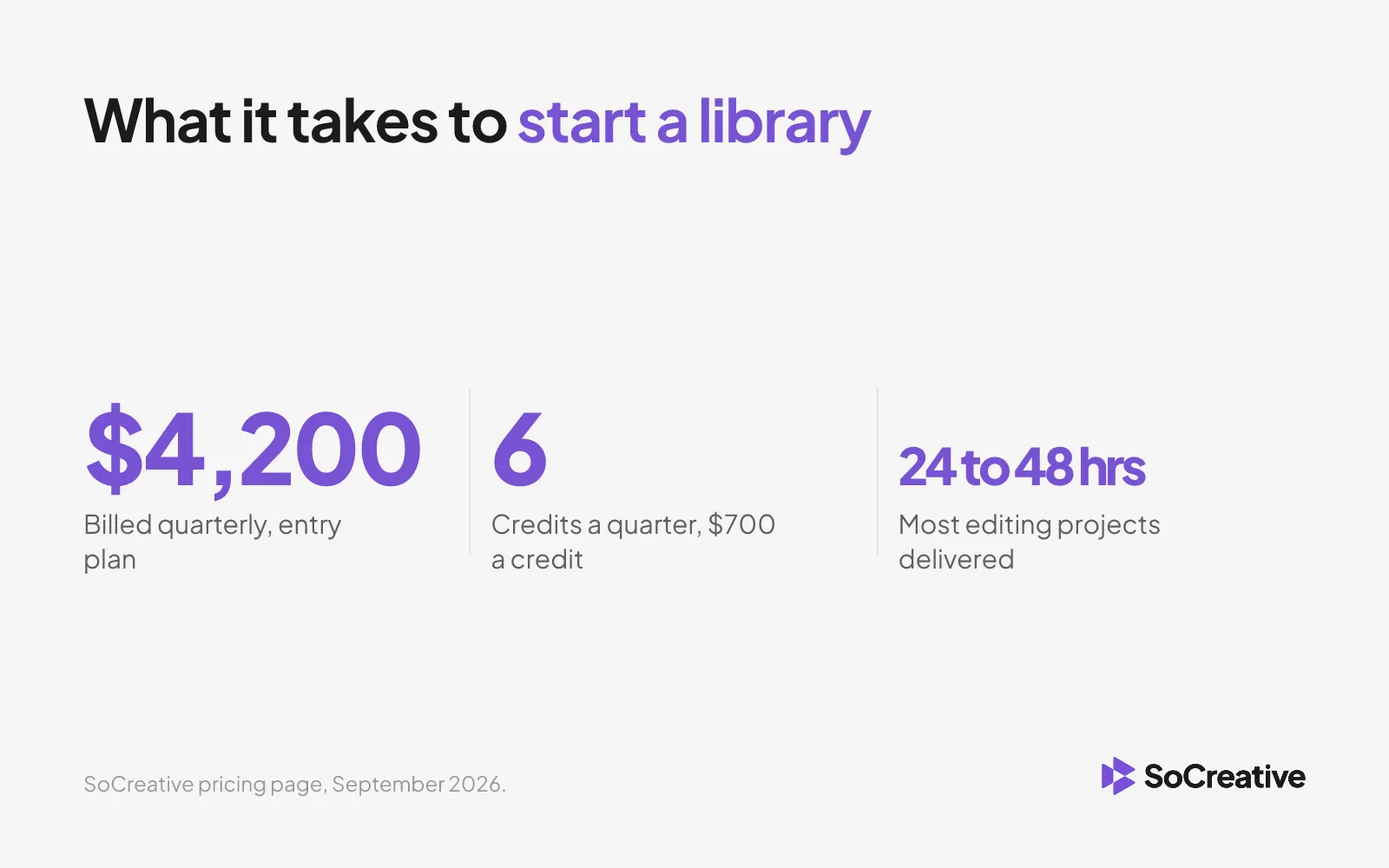
We cover testimonial production alongside product demos, ads, motion graphics and design, on one quarterly credit plan. The entry plan is $4,200 a quarter for 6 credits, at $700 a credit. On-location testimonial shoots run through a global network of vetted videographers, and the same in-house editors finish every one, so a library filmed across five markets still looks like one brand made it.
Strengths
- Credits cover the shoot, the edit, the cutdowns and the design under one plan
- Most editing projects come back in 24 to 48 hours, so a story goes live while it is still fresh
- On-location shoots in most cities without your team sourcing a crew
- A project manager coordinates customer scheduling and shoot logistics, which is the part that usually slips
Limitations
- Plans run on an annual agreement, so a single testimonial is not the right purchase
- Credits assume continuous output across formats, not testimonials alone
Superside
Superside sells a retained creative team covering design and video together, and testimonial work sits inside that. Pricing is published: subscriptions start at a $15,000 monthly minimum on an annual term, plus a $1,000 monthly software fee for platform access, per superside.com/pricing in September 2026.
Strengths
- One retainer covering testimonials, broader video and design
- Built for enterprise volume and enterprise approval cycles
Limitations
- The monthly minimum puts it out of reach for most mid-market teams
- Annual commitment on every subscription
- No production network of its own for on-location shoots
Umault
Umault is a B2B video company known for work that deliberately avoids the standard interview format. Research and competitive analysis sit inside their pre-production, which suits a customer story meant to be the centerpiece of a campaign rather than one of twelve.
Strengths
- Strong creative direction on stories that need to stand out
- Research-led pre-production rather than a template interview
Limitations
- Project-based, so each video is scoped and quoted on its own
- Not built for producing a testimonial every month
Shootsta
Shootsta supplies a capture kit and finishes the footage your team films. For testimonials that means your own people run the customer shoot, which some customers prefer, and Shootsta handles the edit.
Strengths
- Cheaper per video once your team is confident on camera
- Your team keeps the customer relationship end to end
Limitations
- Quality depends on whoever is filming, and a customer interview is an unforgiving thing to film badly
- Annual contracts only, pricing quoted rather than published
Kimp
Kimp sells flat monthly plans for editing and motion graphics through an assigned team. For testimonials it fits brands that already capture customer footage and need it finished consistently.
Strengths
- Predictable flat fee with no quoting per request
- Good at volume of cutdowns and resizes from footage you supply
Limitations
- No shoot support at all, so the hardest part stays with you
- Built for smaller teams
How to choose
How often will you actually produce one? This is the question that decides the model. Four a year is a project purchase. One a month is a capacity purchase, and buying it per project will cost you more in scoping cycles than in production.
Where are your customers? If they sit in three countries, the cost that matters is not the day rate, it is what it takes to find and brief a crew in each market. A partner with a network absorbs that.
Who owns the customer conversation? Some teams want to run the shoot themselves because the relationship is delicate. If that is you, a capture-and-finish model fits. If you would rather hand over the scheduling entirely, buy a partner with a coordination process and hold them to it.
Whatever you pick, plan the library rather than the video. Testimonials compound: one per industry, one per use case, one per buyer persona, and suddenly every stage of the funnel has proof in it. Our pricing page lists what each plan includes if you want to model a year of that.
Frequently asked questions
Testimonials stay the most persuasive thing a B2B brand can publish, and the hardest to produce on a schedule. Decide how many you want in a year, be honest about where your customers are, and buy the model that makes the tenth one as easy as the first.
Written by

SoCreative team