


How much does a video editor cost? The useful answer is the cost per finished video, not the hourly rate or the salary. Add up everything you spend on editing in a year, divide it by the videos that actually ship, and compare that one number across a freelancer, an in-house hire and an external team.
That number is almost always higher than the rate on the invoice or the salary in the offer letter. The rest of this post shows why, and how to work out your own.
How much a video editor costs depends on the cost per finished video, not the hourly rate or the salary. Add every cost line for a year, including tools, management and idle time, then divide by the videos that actually ship. A freelancer is cheapest for one-off work, an in-house hire pays off only when the queue is full every week, and an external team with fixed pricing per deliverable gives you the per-video number before you commit.
Why the hourly rate and the salary both mislead
Most teams compare editors on the number they're quoted. A freelancer's hourly or day rate. An in-house editor's salary. Neither tells you what a finished video costs.
An hourly rate leaves out the hours you don't see quoted. Revisions, file prep, exports for every format and the back and forth on feedback all bill too.
A salary leaves out everything around the person. Software licenses, a machine that can handle 4K footage, storage, recruiting, onboarding, leave and the manager who reviews the work. It also leaves out the weeks when there isn't enough footage to edit.
Picture a team with one editor who spends about a week on each video. That team isn't paying for an editor. It's paying for one video a week, and every other request sits in a queue.

Freelancer vs in-house vs external team
Here is what each model actually charges you for. Fill in your own figures, since rates vary by market, seniority and format.
| Cost line | Freelance editor | In-house editor | External team (fixed pricing) |
|---|---|---|---|
| What you're quoted | Hourly, day or project rate | Annual salary | Price per deliverable |
| Software and hardware | Usually theirs | Yours | Theirs |
| Recruiting and onboarding | Finding and briefing each new freelancer | Recruiting, notice period, ramp-up | One onboarding, then a dedicated team |
| Management time | High: you brief, chase and QA | Medium: you manage the person and the queue | Low: a project manager runs the queue |
| Idle time | None, you pay only when they work | Yours: quiet weeks are still paid | None, you pay per deliverable |
| Capacity in a busy month | Depends on their other clients | One person's week | Several editors on one brief |
| Motion, design and cutdowns | Often a second freelancer | Often a second hire | Usually in the same team |
| When the per-video cost is known | After the invoice | At year end, if you track it | Before you approve the brief |
The pattern we see in delivery: a freelancer is cheapest for a one-off project. An in-house editor pays off only when there is a full queue of footage every week of the year. An external team is the easiest to budget, because the price per video is set before the work starts.

How to work out your cost per finished video
Run these six steps once with last year's numbers. It takes about an hour with a spreadsheet.
-
List every cost line. Write down the salary or freelance spend, then every line around it: editing software, stock music and footage licenses, hardware, storage, recruiting fees and training. For an in-house hire, add benefits and payroll taxes from your finance team.
-
Count finished videos, not hours. Pull the videos that actually shipped last year. Count each cutdown and aspect ratio as its own deliverable, since each one took editing time. This is the number you divide by.
-
Price the idle time. Look at the weeks when your editor waited for footage, approvals or a brief. Those weeks are part of the cost of the videos that did ship. One video a week across about 48 working weeks is roughly 48 videos. Every week lost to waiting takes one off that total.
-
Add the management time. Estimate the hours you and your team spend writing briefs, giving feedback, chasing versions and checking brand rules. Multiply by your own loaded hourly cost. For freelancers this line is often bigger than the invoice.
-
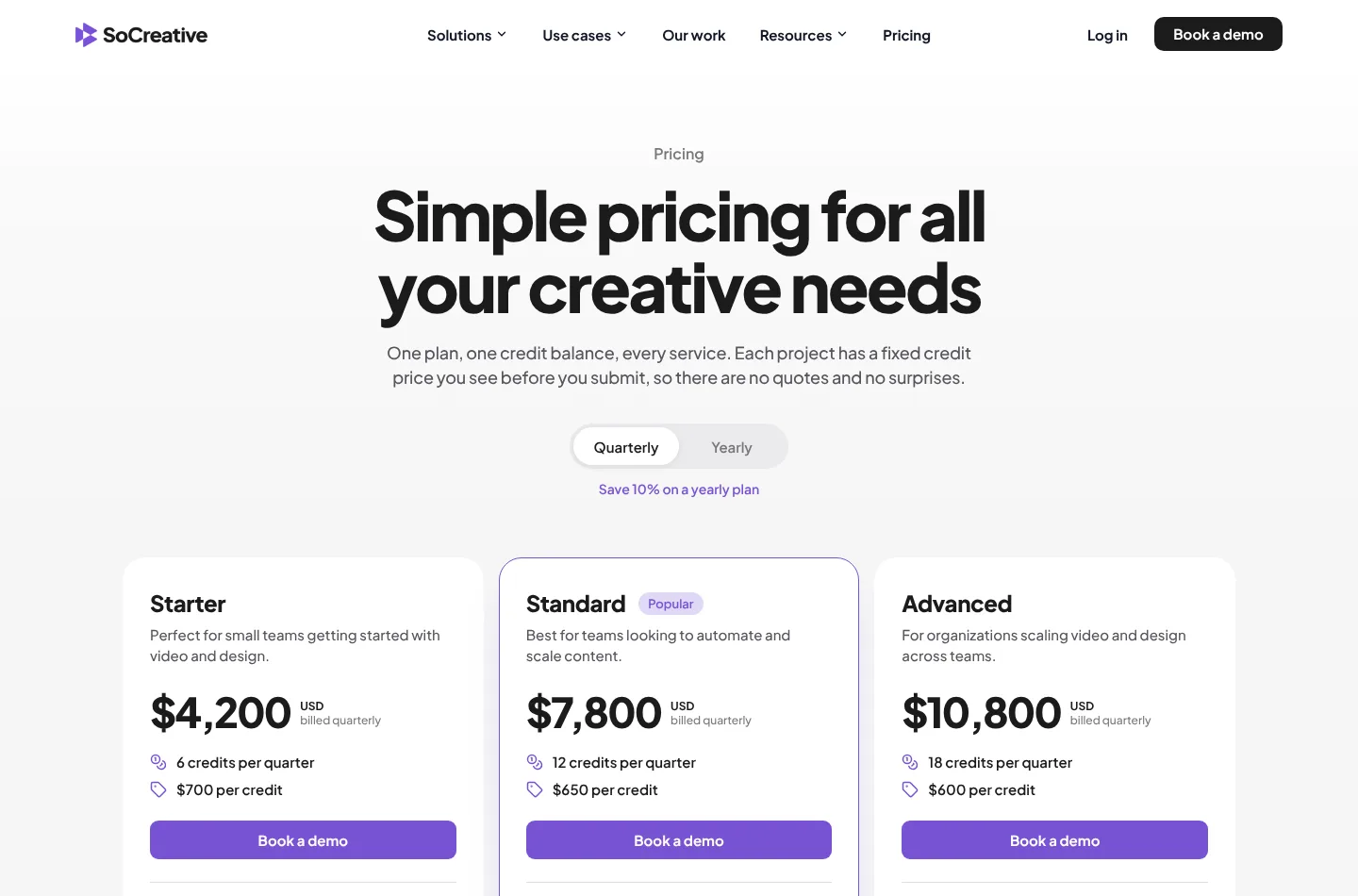
Price the same volume with fixed pricing. Take your list of finished videos and price it against an external team that quotes per deliverable. When you brief an edit through SoCreative, the price per deliverable is set in credits on our pricing page, and first cuts come back in 24 to 48 hours. You see the total before anything is approved, so this column needs no estimating.
-
Decide by volume. Divide each column's total by the number of finished videos from step 2. If your in-house number is lower and your queue is full all year, keep hiring. If it's higher, or your volume swings by quarter, move the overflow or the whole queue to an external team.
What changes when the queue grows
The in-house model scales in steps. One editor gives you one editor's week. The next step up is a second salary, a second license and a second round of recruiting, even if you only need half a person more.
An external team scales by the deliverable. A launch month with 20 cutdowns and a quiet month with four cost what they cost, with no idle salary in between. That's the trade the teams we work with usually make: a small in-house team owns the brand and the ideas, and the volume runs through a dedicated team on fixed pricing. Our breakdown of SoCreative vs in-house teams covers that split in more detail.
Frequently asked questions
How much does a video editor cost per hour?
It depends on market, seniority and format, so ask for quotes in your region. Then convert any hourly rate into a cost per finished video, including revisions and exports, before you compare it with anything else.
What does it cost to hire an in-house video editor?
The salary plus benefits, payroll taxes, software, hardware, storage, recruiting and the time someone spends managing the work. Add the weeks the editor waits for footage or approvals, then divide by the videos that ship.
Is a freelance video editor cheaper than an in-house hire?
For one-off or irregular projects, usually yes, because you pay only when they work. For steady weekly volume, the briefing, chasing and quality checks you do yourself often close the gap.
When does an external video editing team make sense?
When your volume swings by month, when you need motion, design and cutdowns alongside the edit, or when you want the price per video fixed before the work starts. Many teams keep one in-house editor and send the overflow out.
How fast does an external team deliver an edit?
It varies by partner and scope, so ask before you sign. With SoCreative, first cuts come back in 24 to 48 hours, as listed on our pricing page.
One editor finishing one video a week ships about 48 videos a year. Lose ten weeks to waiting and management, and the same salary buys 38. Put your real numbers into the six steps above, and the cheaper column shows itself.
Book a 20-minutewalkthroughSee how teams brief, review and approve
video and design in one platform.Book a demo

Written with AI assistance and reviewed by the SoCreative team.