TL;DR: Creative project management is one intake, one sequencing rule, a named owner per asset, and a review that ends in a decision. Sort the queue on committed money first, then on work that unblocks other work, then oldest first. Cap work in progress at two assets per owner. Two finished beats six half finished. Write handovers, not statuses, and protect one overlap hour per pair of regions. Track five numbers monthly: brief to first cut, revision rounds, first cut acceptance, assets in flight per owner, cost per delivered asset.
You have more creative requests than people to make them, and the requests do not arrive in a useful order. Creative project management is the set of rules that decides what gets made next, who makes it, and when it ships. This is the model we run across a global network of editors, designers and photographers, for many brands at once. It covers intake, sequencing, time zones, and the four numbers that tell you it is working.
What creative project management is
Creative project management is the practice of running creative work as a repeatable pipeline rather than a queue of favors. It has four parts: a single intake that captures what is needed, a sequencing rule that decides order, a named owner for every asset, and a review step that ends in a decision. It covers video, photo and design work from the first request to the delivered file.
The reason it needs its own name is that creative work has a property most other work does not. The requirements are discovered while the thing is being made. A landing page either loads or it does not. A brand film can be technically finished and still wrong, and you only find that out when someone watches it.
How it differs from project management
A project manager protects scope, budget and date. A creative project manager protects those and the work itself. The difference shows up in three places.
The brief. A generic PM accepts the brief as given. A creative PM refuses a brief that has no audience, no single message and no decision maker, because every one of those gaps comes back as a revision round later.
The review. A generic PM collects feedback. A creative PM converts feedback into a decision, and names who made it.
The sequence. A generic PM levels resources. A creative PM knows that two half-finished videos are worth less than one finished one, so work in progress gets capped.
When a spreadsheet is enough
If you ship fewer than about ten assets a month from one or two requesters, a shared spreadsheet and a folder will beat any system you could install. The overhead of a process you do not need is real, and so is the cost of training people to use it.
It stops being enough when two of these are true: more than three people can request work, more than ten assets are in flight at once, or the same asset is being made in two places because nobody could see that it already existed. At that point the spreadsheet stays accurate and stops being useful, because it says nothing about what is stuck.
Intake: one door, one format
Look at where a stalled creative backlog actually begins and it is almost always the intake. Work arrives in direct messages, in meetings, in email threads and in three different project tools, so nobody can see the real queue, and the loudest requester wins.
One door means every request arrives through the same form, in the same shape, before anyone starts work. Five fields are enough:
- What is the asset, and where will it run
- Who is the audience, in one sentence
- What is the single message
- Who signs it off, by name
- When does it need to be live, and what happens if it is late
The last field is the one that does the work. A date with no consequence behind it is a preference, not a deadline, and a queue sorted by preferences is sorted at random.
Two rules keep the door useful. A request that is missing a field goes back, politely and immediately, rather than entering the queue half formed. And anyone may request work, but a named person per team approves what enters the queue, so prioritization happens once instead of in every status meeting.
Sequencing when everything is urgent
Once the queue is visible, everything in it is urgent. Sequencing is the rule you apply when that is true.
We order on three things, in this order. First, anything with external money or a public date behind it: a campaign that is already bought, an event that is already announced. Second, anything that unblocks other work, such as a brand frame or a template that six later assets will reuse. Third, everything else, oldest first.
Oldest first matters more than it sounds. It is the only tie-break that cannot be argued with, and it stops the quiet requester from waiting forever.
Then cap the work in progress. The number that works for us is two assets per owner at a time, with a third allowed only when one is waiting on someone else. A team running six things each will finish them all later than a team running two each, because switching between edits costs more than switching between emails.
The three questions that break a tie
When two requests genuinely tie, these settle it:
- Which one is harder to make later? Shoots with people in them beat anything that can be made at a desk.
- Which one does more than one thing? An asset that serves a campaign and a sales deck outranks one that serves a single post.
- Which one has a decision maker available this week? Work that will sit in review is work that is not finished.
Holding a deadline across time zones
A distributed team is an advantage before it is a problem, but only with a handover that works. Our editors, designers and photographers sit in different countries, and a brief can move through three of them in a day.
Three rules carry it:
Write the handover, not the status. A status says "60 percent done". A handover says what is finished, what is next, where the file is, and the one decision the next person needs. The second one lets someone start inside five minutes of logging on.
One source of truth, and it is not a chat thread. Files, versions, comments and approvals live in one place, timestamped, so the person waking up does not reconstruct the day from messages.
Protect one overlap hour. Fully asynchronous work sounds efficient and quietly adds a day to everything, because the questions that need a conversation wait for one. One hour of deliberate overlap per pair of regions is enough.
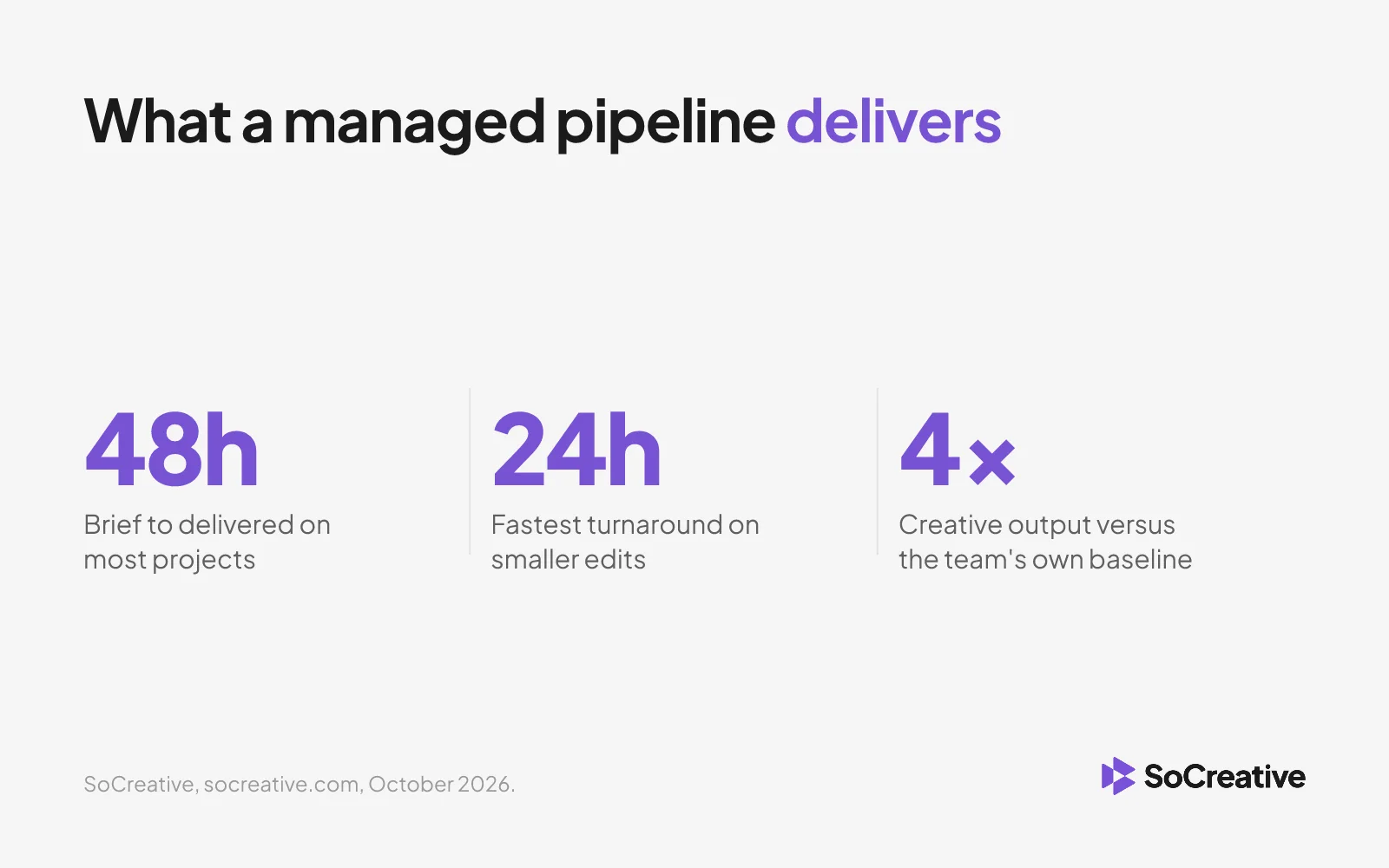
Follow-the-sun is also what makes a 48 hour turnaround possible without anyone working a long night. The brief lands in one region, the first cut is built in another, and the review comes back to the requester's morning. The platform holds the files and the thread; the people do the work. Neither half is optional, and no AI step in the middle removes the editor.
The numbers that tell you it works
Five numbers tell you whether the pipeline is healthy. None of them is output volume, which rises when quality falls.
| Number | What it tells you | Where it goes wrong |
|---|---|---|
| Brief to first cut, in hours | Whether intake and sequencing work | Climbs when requests enter the queue half formed |
| Revision rounds per asset | Whether briefs and reviews are honest | Two is normal for an edit; four means the brief was decided in the review |
| First cut acceptance rate | Whether the brief reached the maker intact | Falls when handovers are statuses rather than decisions |
| Assets in flight per owner | Whether work in progress is capped | Above three, everything slows at once |
| Cost per delivered asset | Whether the model still fits the volume | Rises when rush work and scope changes become normal |
Track them monthly, not weekly. Creative work is lumpy, and a weekly reading mostly measures which week a shoot fell in.
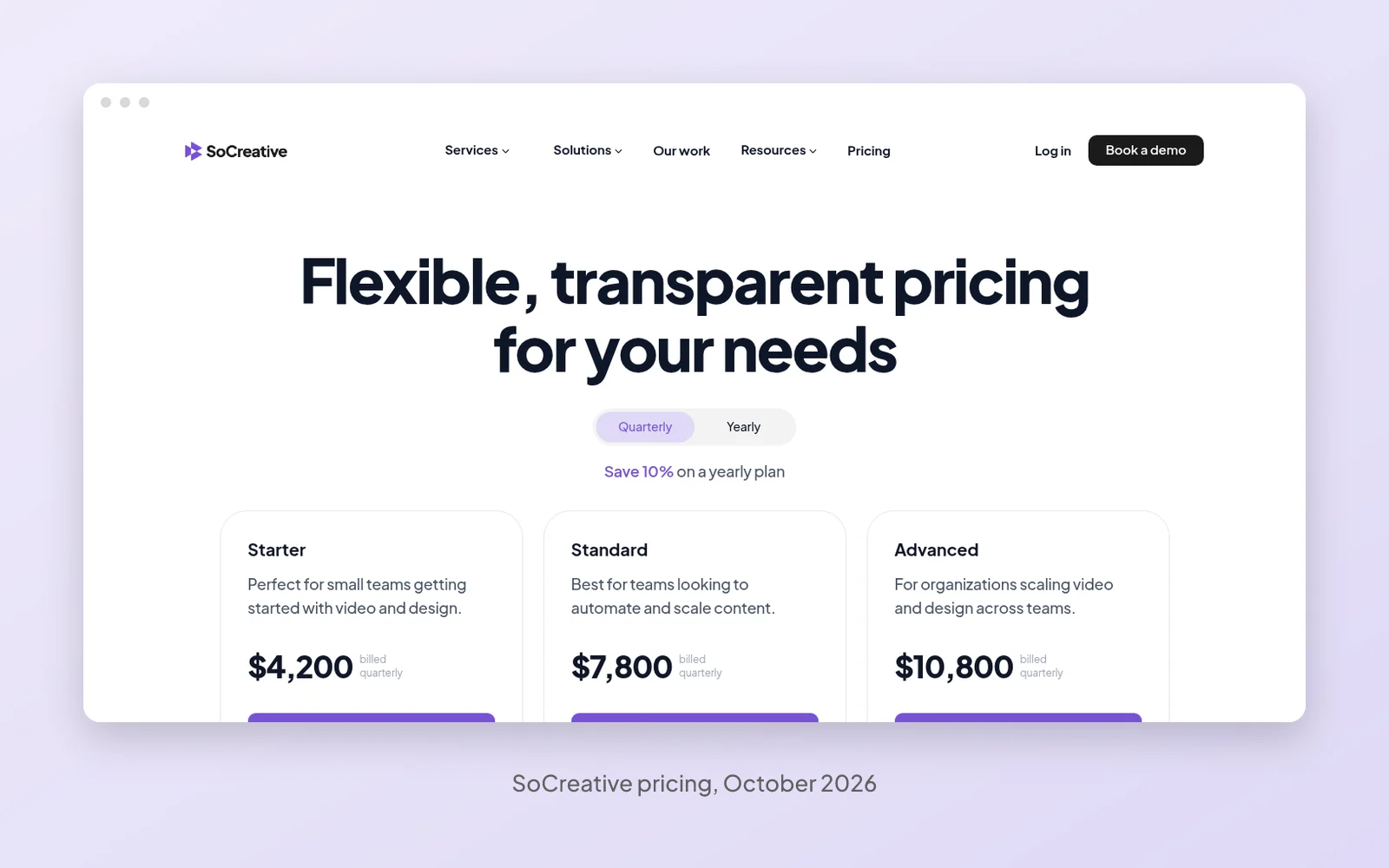
Cost per delivered asset is the one that decides your model rather than your process. Per project pricing is honest at low volume and punishing at high volume, because every request is quoted again. A plan with a fixed price is the opposite. Our own pricing is quarterly credits for that reason: the price is set before the work starts, and the budget does not expire at the end of a month.
Frequently asked questions
Creative project management is not a tool purchase. It is four decisions, written down: how work enters, how it is ordered, who owns it, and who decides when it is done. Make those four explicit and the backlog usually shrinks before anyone is hired, because the delay was in the ordering. Then measure the five numbers above, monthly, and change one thing at a time.

Written by

SoCreative team