
TL;DR: A creative review checks a draft against its brief and ends in a yes or a short list. Run it in one pass: one named approver, all feedback together, timecodes on every note, and the round count agreed before work starts. Most teams review in a thread and find the brand problem on round three. The fix is not a tool, it is deciding who approves and how many times.
A creative review is the step where a draft gets checked against the brief and either approved or sent back. A good one runs in a single pass: one named approver, all feedback collected together, timecodes on every note, and a round count agreed before work starts. Most teams do the opposite. They review in a thread, collect notes for days, and discover the brand problem on round three. The fix is not a better tool. It is deciding who approves, when, and how many times.
TL;DR: A creative review checks a draft against its brief and ends in a yes or a short list. Run it in one pass: one named approver, all feedback together, timecodes on every note, and the round count agreed before work starts. Most teams review in a thread and find the brand problem on round three. The fix is not a tool, it is deciding who approves and how many times.
Your editor is not slow. Your review is. A two day edit that takes three weeks spent nineteen of those days waiting for someone to say yes, or waiting for the fourth person to add a note nobody asked for. We run reviews across many editors and many brands every week, and the pattern holds almost everywhere: round count is set by how a team reviews, not by how well an editor edits.
This post is the process we use, the four things that actually move the round count, and what you can change on Monday without buying anything.
Why revision rounds multiply
Rounds multiply for four reasons, and none of them is craft.
Feedback arrives in waves. The marketing manager sends notes on Tuesday. The product lead adds three more on Thursday. The brand owner sees it on Friday and asks for a different opening. That is three rounds for one edit, and the editor did nothing wrong in any of them.
Nobody owns the yes. When four people can comment and none of them can approve, the edit cannot end. Comments are cheap and approval is expensive, so teams produce a lot of the first and none of the second.
Notes are not locatable. "The middle section drags" costs an editor twenty minutes of guessing. "0:34 to 0:41, cut to the product shot earlier" costs two minutes of work. Same note, different round count.
The brand check happens last. If the logo lockup, the font and the color are checked after the cut is approved, every one of those is a new round on finished work. That is the most expensive round there is, because it reopens an edit everyone had already signed off.
Notice what is missing from that list. Editor skill, brief quality and tooling all matter, but they are not what turns two rounds into six. Sequencing is.
Tooling is worth being precise about. A proofing tool like Ziflow or Frame.io makes notes locatable and timestamped, which is a real fix for one of those four causes.

It cannot name your approver, agree your round count, or move your brand check earlier. Those three are decisions, and no software makes them for you.
The review process, step by step
Five steps. The order is the point.
1. Name one approver before the brief goes out. One person, named in the brief, who can say yes on behalf of the business. Everyone else is a reviewer, and a reviewer's job is to send notes to the approver, not to the editor. If you cannot name that person, the brief is not ready.
2. Agree the round count up front. Two rounds is a normal, honest number for most edits: one substantive pass, one polish. Write it in the brief. A fixed number changes behavior on both sides, because the reviewer knows the first pass has to be complete and the editor knows the second pass is the last.
3. Do the brand check before the first cut ships. Logo placement, type, color, lower thirds, end card, aspect ratios for every placement the asset needs. Check it against the brand guidelines before the reviewer ever sees the cut. A brand error found at round one is a fix. Found at round three, it is a re-edit.
4. Collect all feedback in one pass, with timecodes. Set a window, usually one business day. Every reviewer puts notes in the same place inside that window. Every note on video carries a timecode, every note on design carries the artboard or page. Then the approver reads the whole set, resolves contradictions, and sends one list. Two reviewers asking for opposite things is a decision, not a revision, and it belongs with the approver rather than the editor.
5. Close the round explicitly. "Approved" or "one more pass on these three items". Not silence, and not a new idea. Anything genuinely new becomes the next brief.
A worked example
A testimonial video, four interviews, one hero cut and three social cuts.
The version that takes three weeks: the brief goes out with "marketing team" as the owner. First cut lands Monday. The campaign manager sends notes Tuesday. The product lead adds two on Wednesday, one of which contradicts Tuesday's. The brand owner sees it Friday and asks for the logo animation from the last campaign, which means a new end card on four deliverables. Round four is a color pass. Delivered on day nineteen.
The version that takes four days: the brief names the campaign manager as approver and says two rounds. The brand owner checks the lockup, end card and type against the guidelines on day one, before anyone reviews the cut. First cut goes out Monday with a note saying feedback closes Tuesday at 5pm, timecodes please. Six notes arrive from three people, two of them contradict, and the campaign manager resolves both before sending one list. Round two is a polish pass on three items. Approved Thursday.
Same footage, same editor, same number of opinions. The only difference is the order they arrived in and who was allowed to end it.
What actually drives the round count
Here is what we see when a project runs long. Match the symptom to the cause before you change anything.
| Rounds | What it usually means | The one change that fixes it |
|---|---|---|
| 1 to 2 | Working as intended | Nothing. Protect it |
| 3 | Feedback arrived in waves | One feedback window, one list |
| 4 | No named approver | Name one person in the brief |
| 5 | Brand check happened late | Move the brand check before round one |
| 6 or more | The brief was a conversation, not a brief | Rewrite the brief, restart the clock |
One honest trade-off, because it is the part most articles leave out. Fewer rounds means a stricter brief. If you want to approve in two passes, someone has to decide the message, the length, the placements and the must-include shots before the editor starts. Teams that refuse to make those decisions up front are choosing to make them in the review instead, and that choice is what they are paying for in weeks.
What to change on Monday
Four changes, none of which needs a new tool or a budget line.
Pick your next three briefs and add two lines to each: the approver's name, and the number of rounds. Nothing else changes.
Move your brand check to before the first cut goes out. Whoever owns the brand looks at it once, early, against the guidelines.
Set a feedback window and say it out loud. "Notes by end of Wednesday, in this one place." Late notes go in the next round, not this one.
Ask your reviewers for timecodes. Not a policy, just a request repeated three times until it sticks.
Then count. Track rounds per project for a month. If the number does not move, the problem is the brief, and that is a different post.
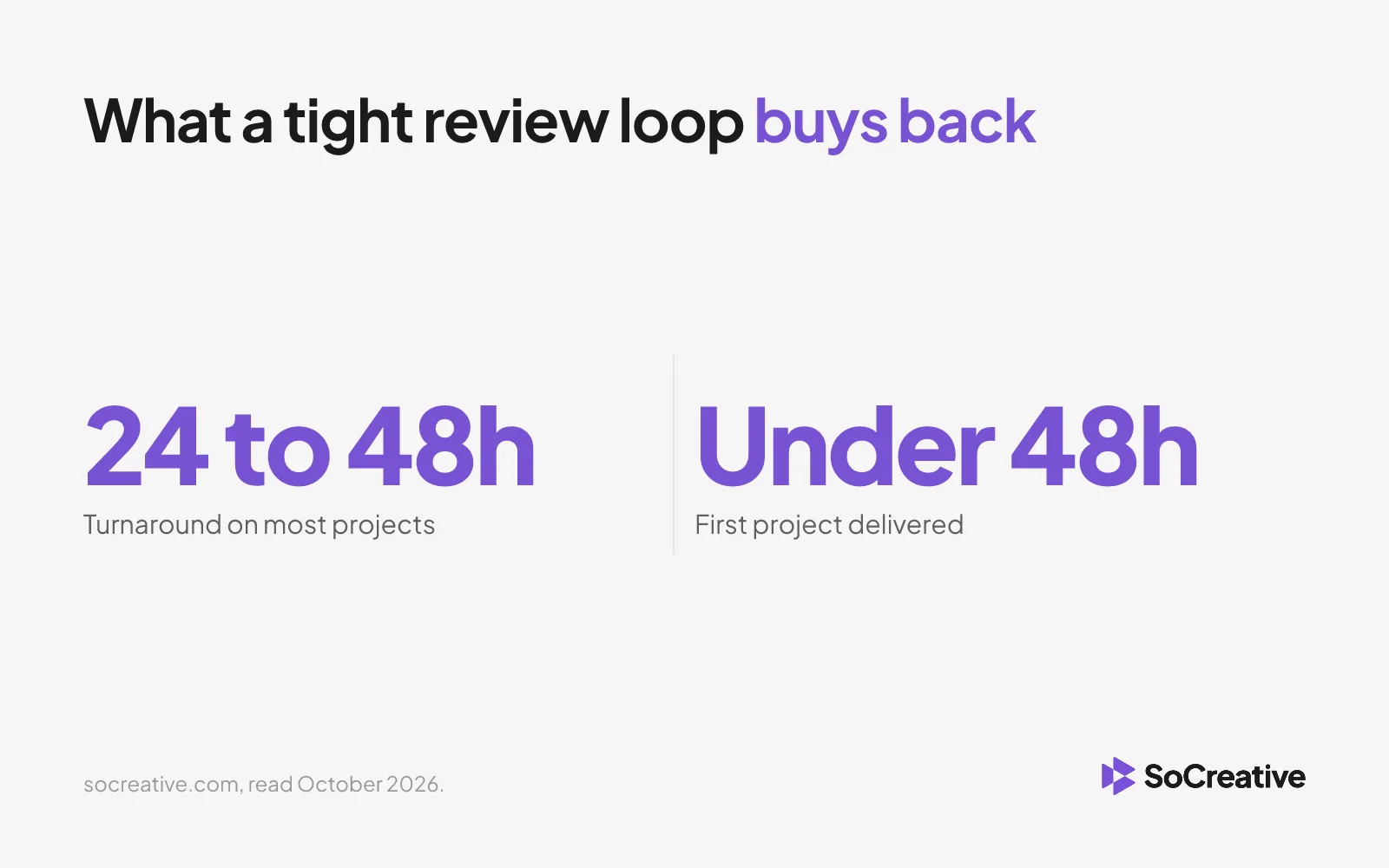
This is also the mechanic behind turnaround claims that sound impossible. We deliver most projects in 24 to 48 hours, and that is not because anyone edits faster than your editor does. It is because a named approver, a single feedback pass and an early brand check remove the waiting.
Frequently asked questions
The short version
Revision rounds are a process output, not a talent problem. Name one approver, agree the round count, check the brand early, and collect feedback in one timecoded pass. Do those four things and most edits land in two rounds. Do none of them and no editor, agency or tool will save the timeline.

Written by

SoCreative team